Plickers is an easy-to-use website/app to do multiple choice review problems in class. All you need is an internet-connected computer, a projector to show the students the questions, and a smartphone with the app. The students hold up answer cards, and you scan their answers with your phone's camera. It works very smoothly!
Harvey Mudd College's math department puts up math fun facts. It is full of really neat stuff! This recommendation was passed on to me by Marc Rios.
Showing posts with label teaching. Show all posts
Showing posts with label teaching. Show all posts
Tuesday, May 26, 2015


Thursday, November 14, 2013
Debate across the curriculum
There are two interesting curricula I have run across recently. Stanford has an "Reading Like A Historian" curriculum, available free of charge: http://sheg.stanford.edu/rlh. The goal is to ask students to read primary sources carefully, evaluate each speaker's motivations and claims, and arrive at a nuanced, triangulated interpretation of events. They have had excellent results so far.
Sounds a lot like debate to me!
Another curriculum I ran into is Deanna Kuhn's program, which is a philosophy class for middle schoolers. They set this up as an experiment: some kids did philosophy through debate, while the control group kids did philosophy through lecture, reading, and writing alone. The results were quite impressive.
I've been a fan of Deanna Kuhn for at least a decade. She has a new book, Education for Thinking. Here is an excerpt of her writing (but not necessarily her book) from her website:
Her book was interesting. She described several investigative tasks; the music club one was easily replicable from her thorough description and sounded quite neat. She also had some interesting things to say about how to structure an introductory debate activity that would be neat for coaches who work with very novice debaters. Dr Kuhn had a key point about bootstrapping: when students knew little about the context and had few critical thinking skills, the teacher needs to have good structure set up so the students can bootstrap their way into both subject and skills.
Dr Kuhn's clearest call for reform was to create a specific focus across all classes on critical thinking skills. As she wrote in the book,
I think the goal of education is not information transfer, per se, but the ability to make a sustained argument, to critically evaluate sources and ideas, and to learn to investigate systematically (which could be a scientific experiment or a comparison of all available historical sources).
Putting the child at the center -- by asking him to debate an issue, to do an experiment, to discover a mathematical idea -- has two main benefits. First, he is actually spending his time on the important task itself (instead of endlessly preparing with rote memorizing for the day -- way off in grad school -- when he might be allowed to investigate anything on his own).
Sounds a lot like debate to me!
Another curriculum I ran into is Deanna Kuhn's program, which is a philosophy class for middle schoolers. They set this up as an experiment: some kids did philosophy through debate, while the control group kids did philosophy through lecture, reading, and writing alone. The results were quite impressive.
I've been a fan of Deanna Kuhn for at least a decade. She has a new book, Education for Thinking. Here is an excerpt of her writing (but not necessarily her book) from her website:
But aren't children naturally inquisitive? Are inquiry skills something that really need to be developed? The image of the inquisitive preschool child, eager and energetic in her explorations of a world full of surprises, is a compelling one. But the image fades as the child grows older, most often becoming unrecognizable by adolescence, if not middle childhood. What has happened to the "natural" inquisitiveness of early childhood? In part its nurturance into adolescence and adulthood rests on a set of values that parents and teachers must convey and support. But equally important is the channelling of this inquisitive energy into development of the cognitive skills that make for effective inquiry. The skills originate in early childhood, with achievement of the epistemological understanding that knowledge originates in human minds, is fallible, and has the potential for disconfirmation in the face of evidence. Only then does the coordination of theories and evidence that is a hallmark of authentic scientific inquiry become possible. In sum, the so-called "natural" curiosity that infants and young children show about the world around them needs to be enriched and directed by the tools of scientific thinking.
Her book was interesting. She described several investigative tasks; the music club one was easily replicable from her thorough description and sounded quite neat. She also had some interesting things to say about how to structure an introductory debate activity that would be neat for coaches who work with very novice debaters. Dr Kuhn had a key point about bootstrapping: when students knew little about the context and had few critical thinking skills, the teacher needs to have good structure set up so the students can bootstrap their way into both subject and skills.
Dr Kuhn's clearest call for reform was to create a specific focus across all classes on critical thinking skills. As she wrote in the book,
By examining causality in a biological context, a geographical context, a mechanical context, an interpersonal context, a sociological context, and any number of other contexts, students begin to understand and appreciate features of causality itself.
I think the goal of education is not information transfer, per se, but the ability to make a sustained argument, to critically evaluate sources and ideas, and to learn to investigate systematically (which could be a scientific experiment or a comparison of all available historical sources).
Putting the child at the center -- by asking him to debate an issue, to do an experiment, to discover a mathematical idea -- has two main benefits. First, he is actually spending his time on the important task itself (instead of endlessly preparing with rote memorizing for the day -- way off in grad school -- when he might be allowed to investigate anything on his own).
Second, the child is far more engaged in his work, because he has been given agency and purpose. Purpose: answer this question. Agency: it is up to you to answer this question, with some help if you need it, but no one is going to do it for you!
Friday, November 1, 2013
Metaphors, misconceptions, and doing mathematics
In our brains, there are some hardwired, a priori ideas. For lack of a better word, they are innate. Built-in. I've been reading Where Mathematics Comes From, by George Lakoff (yes, the Lakoff who analyzes political metaphors), and they try to root out some of the basic images, ideas, or metaphors that we layer upon to build mathematical thinking. I have not finished reading the book, but there is obviously a qualitative shift that happens for every student from innate to learned. While greater than-less than is probably an innate idea when we talk about the size of physical objects, all the ideas about greater than-less than with numbers or variables is learned. Clearly, the ideas about comparing the size of numbers or variables layer upon the innate understanding -- at first we reason by analogy to physical size, i.e., a group of six things is bigger than a group of four things. If, by chance, we met someone who could not grasp the idea of comparing physical sizes, we would think it quite odd and have a hard time helping them learn math. Yet despite the fundamental nature of the innate ideas, we know that most ideas in mathematics have to be learned. Plato gets himself into phenomenal trouble (pun deeply intended) by thinking that all mathematical ideas are a priori -- essentially, memories -- and not learned.
What is a mathematical concept or idea? It is actually really just a set of relationships (built up from some very basic, innate idea, perhaps). For example, "equilateral triangle" is a set of relationships: what a side is, what a polygon is, what equal lengths are -- and that is just the definition. Then all sorts of other properties get tied in: that its angles are equal, how to find the length of its altitude, how to find its area, that its altitude is its median is its angle bisector, that all the properties true for isosceles triangles are also true for equilateral triangles, the relationship of its inscribed circle's area to its circumscribing circle's area, how to tessellate it, etc., etc. To take another dig at Plato, he might say that this complexity shows equilateral triangles are the basis of all reality! (Yes, he really thought this.) Sorry, Plato, a lot of concepts are this interconnected.
What goes wrong when a student does not understand a concept?
One particular example of overgeneralizing that drives me nuts: CPCTC. For those who are not geometry teachers, this means "corresponding parts of congruent triangles are congruent." A rather obvious property, once you think about it, which should not really merit a name. Yet students overapply this like crazy. At one point, I had to scold my students: "CPCTC is not magic pixie-dust that you sprinkle on your work whenever you hope a miracle will happen!"
We teachers can feed into this, of course, by overgeneralizing. My worst example is the prohibition against side-side-angle congruence. We tell students it does not work, but that is an overgeneralization. Side-side-angle WILL work if the angle given is right or obtuse. And it even works for acute angles if the opposite side is longer than or equal to the adjacent side. It really only fails to prove congruence in one instance: given an acute angle and the adjacent side longer than the opposite side. So why do we tell our students to avoid this method of proving congruence? It actually makes a fun problem to foray into. Here is a fun little GeoGebra to begin exploring the ideas.
Aside from failure (1), the others are accurately called "misconceptions." The students think they have the idea, which makes it especially challenging to correct. I am going to quote Shawn Cornally at length here about how to root out misconceptions:
Ben Orlin has a great post where he compares doing mathematics to rock-climbing. It is worth reading in its entirety, but here is the part that struck me.
This strikes me as just right. Mathematics is supposed to be elegant, flexible, graceful, and subtle. The attitude of a student who does math "like a man" is abetted by a curriculum that allows that approach to be somewhat successful. I think a good curriculum ought to convince students fairly quickly that this is a dead-end approach; I have written about it here, here, and here. To summarize, a student who does math "like a man" probably never had a teacher "tee up" to a misconception.
One last thought: I have a meta-study guide I give my students at several points during the year. I want to emphasize to them that studying -- good, effective studying -- is about thinking conceptually, rooting out misconceptions, and working to understand things. My guide gives them some concrete suggestions to do so on their own.
What is a mathematical concept or idea? It is actually really just a set of relationships (built up from some very basic, innate idea, perhaps). For example, "equilateral triangle" is a set of relationships: what a side is, what a polygon is, what equal lengths are -- and that is just the definition. Then all sorts of other properties get tied in: that its angles are equal, how to find the length of its altitude, how to find its area, that its altitude is its median is its angle bisector, that all the properties true for isosceles triangles are also true for equilateral triangles, the relationship of its inscribed circle's area to its circumscribing circle's area, how to tessellate it, etc., etc. To take another dig at Plato, he might say that this complexity shows equilateral triangles are the basis of all reality! (Yes, he really thought this.) Sorry, Plato, a lot of concepts are this interconnected.
What goes wrong when a student does not understand a concept?
- Failure of imagination: They are having trouble understanding the basic idea, connecting it or analogizing it to innate ideas and/or ideas they already understand.
- Failure of wrong picture: They think they have the right picture, but the analogy is wrong.
- Failure of oversimplified heuristic: The basic idea is right, but the student has a shortcut that is insufficiently complex to solve problems. In other words, the foundational understanding is there, but the mathematical thinking that has been layered on top is sketchy.
- Failure of overgeneralizing: They understand an idea and know the mathematical strategies, too, but they apply this idea inappropriately. Connections to other ideas are supposed to enrich an idea AND LIMIT it. For example, students should use isosceles triangle properties on equilateral triangles -- but not in the other direction! Yet many see the ideas map in one direction, and assume both directions of idea-mapping are acceptable.
One particular example of overgeneralizing that drives me nuts: CPCTC. For those who are not geometry teachers, this means "corresponding parts of congruent triangles are congruent." A rather obvious property, once you think about it, which should not really merit a name. Yet students overapply this like crazy. At one point, I had to scold my students: "CPCTC is not magic pixie-dust that you sprinkle on your work whenever you hope a miracle will happen!"
We teachers can feed into this, of course, by overgeneralizing. My worst example is the prohibition against side-side-angle congruence. We tell students it does not work, but that is an overgeneralization. Side-side-angle WILL work if the angle given is right or obtuse. And it even works for acute angles if the opposite side is longer than or equal to the adjacent side. It really only fails to prove congruence in one instance: given an acute angle and the adjacent side longer than the opposite side. So why do we tell our students to avoid this method of proving congruence? It actually makes a fun problem to foray into. Here is a fun little GeoGebra to begin exploring the ideas.
Aside from failure (1), the others are accurately called "misconceptions." The students think they have the idea, which makes it especially challenging to correct. I am going to quote Shawn Cornally at length here about how to root out misconceptions:
- You have to tee up the misconceptions. This does not look like simply saying the misconception followed by the “correct” model. This does look like getting the students to display their dizzying array of pre(mis)conceptions. Use whiteboards, video tape each other and compile it, and come to a consensus–even if it’s the wrong consensus.
- You have to provide an experience that frustrates and confuses. This is based on some awesome neuroscience; basically, the human brain is not like a computer file system. When you edit the file on a computer, the magnetic dipole or electronic domain are flipped with an application of current. Human memories are repetitive, sensory-correlated, and plastic. You have to have the file open, and you have to chisel at it repetitively from different angles, and the misconceptions will often spend some time living in bizarre discord with the more appropriate model. This is ok, if not somewhat drawn out.
- You have to measure the extensibility of the new model. Can the student take the new model on the road? Is their understanding of rates limited to iterations of meters and seconds, or can they take that and apply it to dollars per volume? Have you measured their abstraction level?
* * *
Ben Orlin has a great post where he compares doing mathematics to rock-climbing. It is worth reading in its entirety, but here is the part that struck me.
Too many students think math ability lies along a single axis. But soon they discover the sprawling taxonomy of mathematical skills. There’s speed--in computing, in connecting, in spotting errors. There’s organization--of arithmetic, of arguments, of ideas. There’s understanding--of concepts, of technicalities, of deep truths. And so on. When you’re doing math, you’re not just a single mechanism. You’re a whole brain...
Lots of students try to do math like a man. They stare intently at an example, and then tackle a practice problem, diligently striving to reproduce the method step for step. Sweat gathers on their brow. It’s a draining, painful process, and not at all how math is meant to be done. Like rock-climbing, math rewards the nimble. People who employ their full toolbox fare better than ones who rely exclusively on memorization and formalisms.
This strikes me as just right. Mathematics is supposed to be elegant, flexible, graceful, and subtle. The attitude of a student who does math "like a man" is abetted by a curriculum that allows that approach to be somewhat successful. I think a good curriculum ought to convince students fairly quickly that this is a dead-end approach; I have written about it here, here, and here. To summarize, a student who does math "like a man" probably never had a teacher "tee up" to a misconception.
One last thought: I have a meta-study guide I give my students at several points during the year. I want to emphasize to them that studying -- good, effective studying -- is about thinking conceptually, rooting out misconceptions, and working to understand things. My guide gives them some concrete suggestions to do so on their own.
Saturday, October 19, 2013
Scrivener
I must endorse Scrivener, a word processing/book writing program. I've been using it for about a year, and it's fantastic. (And I'm not being paid or being given anything by them.)
The program is available for Mac and PC. It costs $45 for Mac, $40 for PC (and knock about 12% off for the education discount). It's easy to use, and far, far superior to Word for composing long-form files. Three specific uses have occurred to me: 1) for teachers writing a test bank, 2) for math teachers writing a problem set, and 3) for debaters to go paperless (and yes, I think it's better than going paperless by using Word templates, but it depends on the debater's personality and the squad setup).
But first, I'll give you a basic overview of the program. The screen layout is customizable, but this layout shows you three elements of the program: the Binder (left-hand pane), the editing window, and comments/footnotes (right-hand pane).

The document editing window is just like Word's draft or online layout view. The Binder allows you to sort your work into subdocuments. You can go as many levels deep as you want to. Note the research folder -- more on this later. The right pane is the Inspector. Footnotes, comments, meta-tags, and even more tools to annotate your work as you go. Note the Compile button in the top center. This is the "print" function, but unlike Word, there is a lot of control over what you print. You decide which subdocuments to print, whether comments or footnotes print, etc.
I have ten versions of the chapter 2 test saved on my computer in Word. I'm not sure how exactly they differ. I rotated some problems out but kept some. I merely reordered some problems to create different forms of the same test for different periods. I would have to open all ten versions and spend two or three hours to sort out this mess.
It's much, much easy to keep a complete test bank in Scrivener and then to print only the questions you need for a given version. Option 1 is to make a Scrivener file for each test and to make each type of question a different document in the Binder. For example, you might have a document for true/false questions, short answer questions, essays, or document-based-questions. You can write the instructions for that type of question once. Then, each question would be a subdocument. You can reorder subdocuments by dragging-and-dropping to create different test forms. Unselect a question from "compile" and it will not print in this year's test but will remain safely stored in the bank. Best yet, you can use the inspector to give each question meta-tags: topic, difficulty, LAST YEAR USED, etc. Furthermore, you can keep all the support documents you want in the Research section of the Binder. For example, you can import PDFs and html files into Scrivener for your document-based-questions, printing them only when the questions you give your students necessitate it. (You can also import your old tests from Word files, so you don't need to retype everything.)
Option 2 is to aim even higher, making one Scrivener file your whole-year test and exam bank. You would need to make a different document for each unit, and then subdivide each of these documents into separate, appropriate subdocuments (such as question type). Since there's no limit on how many levels deep you can go, it seems like making a bank for the entire year should not be a problem. You can keep records of how students do from year to year in Scrivener in a subdocument you never print. You never need to misplace your data again!
Scrivener has a special advantage: MathType can easily be integrated. A further advantage: you can use the comments/meta-tags field to categorize problems by concept or difficulty, to write in the solutions to problems, and to make notes on what problems students find the most challenging. You can also insert tables and graphics for your problems and -- this is the best part -- you can import the source files, in whatever format you have, directly into Scrivener. Data is in Excel? Drag your Excel document in, and it'll live safely in your Scrivener file. GeoGebra file? Drag it in! The GeoGebra file will live safely in the Research section of the Binder.
When you click on an imported file, the appropriate program will start. For example, clicking on a Excel document in the Research section will cause Excel to start and open the file. However, these imported files are not "linked." You can't edit the Excel document and have those changes reflected in Scrivener. You have to copy the updated data from Excel back into your document. And you have to reimport the Excel file itself. But you can delete the original file, and the copy will live in Scrivener, and you never need to worry about losing it. Before I started using Scrivener, I would make my diagrams in GeoGebra, then throw the GeoGebra file away. It just got to be too much to manage all of them. But now with Scrivener, now I can keep all of my GeoGebra files neatly organized.
While I'm on it, GeoGebra is awesome. It's easy to use; it's pretty darn powerful; it integrates geometry and algebra and functions and even statistics; it's stable; and it's free! I make almost all my diagrams, from my Geometry to my B.C. Calculus class, in GeoGebra -- the only exception is 3D stuff. Download it for free here. It's available for PC, Mac, Linux, as an add-on for Chrome (it's a little slow but alright), as a iPad app, as an Android app, and as a Windows tablet app.
Anyway, back to Scrivener. The one downside is that you can't do fancy page layouts. You can resize an image, but you can't rotate it. You can make a table, but you can't combine cells or resize them beyond the default. You can't double-column or do tab stops. Or auto-numbering. Header and footer options are limited. However, you can export your document to a Word file where you could do those things. I think those deficiencies are far outweighed by the positives. Scrivener makes no claim to be a layout program; its goal is to help you write and edit your rough drafts, and mostly, I think its draft quality (as it were) is good enough for making a math problem set!
The Binder can be a tub or accordion file, organized into different sections, e.g., neg > disads > econ da > links > ACA > specific cards or briefs. There are heading and subheading text styles, which could the tags, and the body text style could be the card text. The footnotes could be the citations, and comments the debater's annotations on each card or brief.

Here's the template I created.
Everything is at your fingertips, in one file (no need to open separate Word documents). Scrivener doesn't seem to have any size problems. Because it's designed to write books, it clearly can handle a lot (as opposed to opening up an equivalent number of files in Word, which does seem to tax my computer). The best part is that everything is searchable and search results can be filtered, e.g. a student can find a link card with a specific phrase even if he can't remember which disad it's a part of.
I imagine that a debater would use Scrivener to a) import his research files, in PDF, html, or Word documents; b) use Scrivener to write his briefs; and then c) use Scrivener in round as his document system. I imagine that he would work from a copy in each round, so he doesn't screw anything up permanently by accident. I would want my debaters to create a document for each speech at the top of the Binder, and then drag-and-drop the evidence they need to read into each speech document. The best part is that, when they need to share evidence with opponents, the "compile to PDF" option is awesome. The debaters can select only what they've read, and while the footnotes can be printed, the comments/annotation don't have to be printed.
The only difficulty is with sharing. It's easy to import files, but you can't use Scrivener to collaborate. I could imagine a team of two using one Scrivener file, synced through Google Drive or Dropbox, but I can't imagine a whole squad doing so.
Scrivener is a great program. It's super easy to import into; it's super easy to use; and it's super easy to export into different formats for final editing for page layout. Plus, they'll give you a free trial.
The program is available for Mac and PC. It costs $45 for Mac, $40 for PC (and knock about 12% off for the education discount). It's easy to use, and far, far superior to Word for composing long-form files. Three specific uses have occurred to me: 1) for teachers writing a test bank, 2) for math teachers writing a problem set, and 3) for debaters to go paperless (and yes, I think it's better than going paperless by using Word templates, but it depends on the debater's personality and the squad setup).
But first, I'll give you a basic overview of the program. The screen layout is customizable, but this layout shows you three elements of the program: the Binder (left-hand pane), the editing window, and comments/footnotes (right-hand pane).

The document editing window is just like Word's draft or online layout view. The Binder allows you to sort your work into subdocuments. You can go as many levels deep as you want to. Note the research folder -- more on this later. The right pane is the Inspector. Footnotes, comments, meta-tags, and even more tools to annotate your work as you go. Note the Compile button in the top center. This is the "print" function, but unlike Word, there is a lot of control over what you print. You decide which subdocuments to print, whether comments or footnotes print, etc.
For teachers writing a test bank
I have ten versions of the chapter 2 test saved on my computer in Word. I'm not sure how exactly they differ. I rotated some problems out but kept some. I merely reordered some problems to create different forms of the same test for different periods. I would have to open all ten versions and spend two or three hours to sort out this mess.
It's much, much easy to keep a complete test bank in Scrivener and then to print only the questions you need for a given version. Option 1 is to make a Scrivener file for each test and to make each type of question a different document in the Binder. For example, you might have a document for true/false questions, short answer questions, essays, or document-based-questions. You can write the instructions for that type of question once. Then, each question would be a subdocument. You can reorder subdocuments by dragging-and-dropping to create different test forms. Unselect a question from "compile" and it will not print in this year's test but will remain safely stored in the bank. Best yet, you can use the inspector to give each question meta-tags: topic, difficulty, LAST YEAR USED, etc. Furthermore, you can keep all the support documents you want in the Research section of the Binder. For example, you can import PDFs and html files into Scrivener for your document-based-questions, printing them only when the questions you give your students necessitate it. (You can also import your old tests from Word files, so you don't need to retype everything.)
Option 2 is to aim even higher, making one Scrivener file your whole-year test and exam bank. You would need to make a different document for each unit, and then subdivide each of these documents into separate, appropriate subdocuments (such as question type). Since there's no limit on how many levels deep you can go, it seems like making a bank for the entire year should not be a problem. You can keep records of how students do from year to year in Scrivener in a subdocument you never print. You never need to misplace your data again!
For math teachers writing a problem set
Scrivener has a special advantage: MathType can easily be integrated. A further advantage: you can use the comments/meta-tags field to categorize problems by concept or difficulty, to write in the solutions to problems, and to make notes on what problems students find the most challenging. You can also insert tables and graphics for your problems and -- this is the best part -- you can import the source files, in whatever format you have, directly into Scrivener. Data is in Excel? Drag your Excel document in, and it'll live safely in your Scrivener file. GeoGebra file? Drag it in! The GeoGebra file will live safely in the Research section of the Binder.
When you click on an imported file, the appropriate program will start. For example, clicking on a Excel document in the Research section will cause Excel to start and open the file. However, these imported files are not "linked." You can't edit the Excel document and have those changes reflected in Scrivener. You have to copy the updated data from Excel back into your document. And you have to reimport the Excel file itself. But you can delete the original file, and the copy will live in Scrivener, and you never need to worry about losing it. Before I started using Scrivener, I would make my diagrams in GeoGebra, then throw the GeoGebra file away. It just got to be too much to manage all of them. But now with Scrivener, now I can keep all of my GeoGebra files neatly organized.
While I'm on it, GeoGebra is awesome. It's easy to use; it's pretty darn powerful; it integrates geometry and algebra and functions and even statistics; it's stable; and it's free! I make almost all my diagrams, from my Geometry to my B.C. Calculus class, in GeoGebra -- the only exception is 3D stuff. Download it for free here. It's available for PC, Mac, Linux, as an add-on for Chrome (it's a little slow but alright), as a iPad app, as an Android app, and as a Windows tablet app.
Anyway, back to Scrivener. The one downside is that you can't do fancy page layouts. You can resize an image, but you can't rotate it. You can make a table, but you can't combine cells or resize them beyond the default. You can't double-column or do tab stops. Or auto-numbering. Header and footer options are limited. However, you can export your document to a Word file where you could do those things. I think those deficiencies are far outweighed by the positives. Scrivener makes no claim to be a layout program; its goal is to help you write and edit your rough drafts, and mostly, I think its draft quality (as it were) is good enough for making a math problem set!
Debaters going paperless
The Binder can be a tub or accordion file, organized into different sections, e.g., neg > disads > econ da > links > ACA > specific cards or briefs. There are heading and subheading text styles, which could the tags, and the body text style could be the card text. The footnotes could be the citations, and comments the debater's annotations on each card or brief.
Here's the template I created.
Everything is at your fingertips, in one file (no need to open separate Word documents). Scrivener doesn't seem to have any size problems. Because it's designed to write books, it clearly can handle a lot (as opposed to opening up an equivalent number of files in Word, which does seem to tax my computer). The best part is that everything is searchable and search results can be filtered, e.g. a student can find a link card with a specific phrase even if he can't remember which disad it's a part of.
I imagine that a debater would use Scrivener to a) import his research files, in PDF, html, or Word documents; b) use Scrivener to write his briefs; and then c) use Scrivener in round as his document system. I imagine that he would work from a copy in each round, so he doesn't screw anything up permanently by accident. I would want my debaters to create a document for each speech at the top of the Binder, and then drag-and-drop the evidence they need to read into each speech document. The best part is that, when they need to share evidence with opponents, the "compile to PDF" option is awesome. The debaters can select only what they've read, and while the footnotes can be printed, the comments/annotation don't have to be printed.
The only difficulty is with sharing. It's easy to import files, but you can't use Scrivener to collaborate. I could imagine a team of two using one Scrivener file, synced through Google Drive or Dropbox, but I can't imagine a whole squad doing so.
Summary
Scrivener is a great program. It's super easy to import into; it's super easy to use; and it's super easy to export into different formats for final editing for page layout. Plus, they'll give you a free trial.
Thursday, September 26, 2013
A problem-centered math curriculum
I like the gardening metaphor for education. The children are the plants; the teachers are the gardeners; and the teachers' job is to create good conditions for the plants to grow. The metaphor reminds me that the learning is a product of my students' own efforts to understand the concepts and do the problems; however much I might do, I can't grow for my plants. Er, students. My number one rule as a teacher is, "The children are supposed to be doing the thinking." Watching me do math on the board is like a pep talk to my tomato plants. I'm not opposed to telling them how to do problems; it's just that I recognize how much practice they need on their own. So, I water my plants with carefully curated, appropriately challenging problems. I weed, watching my students work and correcting their errors. I give my plants fertilizer: ... hmm. Well. I guess this is like formal definitions and concepts -- a little bit can help the students' grow very rapidly, but too much can burn the soil.
The problem with the metaphor is that it sounds so peaceful; it is nothing like the lived experience of teaching this way. I give a micro-lecture on a concept. I am very conscious of how much I talk. As a former debater, I could prattle on endlessly, but I try to keep it very brief. Then I pick questions I think are appropriately challenging -- ones they can do but that stretch them a bit -- but sometimes I pick wrong. It's tricky: if the problem is too complex, then too-many details will overwhelm the students; if it is too easy, the students won't have to do any mathematical thinking, just recall of previously-learned facts. I write up a problem and am met by blank stares. Time ticks by in fractions of hundredths of a second.
Do I give a hint to give them an in-road, or is that cutting them too much slack? By definition, appropriately challenging questions are at the periphery of their knowledge, so the first steps are from safe territory into unknown lands; they are tentative and do not need to be rushed. The creeping roar of silence in my ears is loud. I am thinking back to graduate school, where we watched videos of U.S. math teachers and videos of other nations' math teachers. The U.S. teachers asked easy "yes-no" or other simple questions; they rattled the questions of rapid-fire, giving students only a few seconds to answer. We don't play that game in my classroom. They've been thinking for a while now, and the wheels are now beginning to turn. Many students are scratching diagrams or ideas down. I sweep the room for the stragglers who are truly stuck, and then we're off and running, and the real work begins in earnest. The complete silence lasted for no more than a minute.
Do I give a hint to give them an in-road, or is that cutting them too much slack? By definition, appropriately challenging questions are at the periphery of their knowledge, so the first steps are from safe territory into unknown lands; they are tentative and do not need to be rushed. The creeping roar of silence in my ears is loud. I am thinking back to graduate school, where we watched videos of U.S. math teachers and videos of other nations' math teachers. The U.S. teachers asked easy "yes-no" or other simple questions; they rattled the questions of rapid-fire, giving students only a few seconds to answer. We don't play that game in my classroom. They've been thinking for a while now, and the wheels are now beginning to turn. Many students are scratching diagrams or ideas down. I sweep the room for the stragglers who are truly stuck, and then we're off and running, and the real work begins in earnest. The complete silence lasted for no more than a minute.
I walk around the classroom and am a triage nurse and ER doctor, rolled into one. I try my best to diagnose problems at a glance. Wrong concept. Oops, an algebra mistake here. Simple addition error. Solid work, you. And I must decide who's going to be able to catch their own error and self-correct. It depends on the kid, on the concept, and on the type of error. Simple addition errors and algebra mistakes are rarely noticed. Those need to be pointed out, but some kids require a very delicate correction because they'll erase all of their work -- and I do mean all of it -- if they don't realize it's only a very minor error. Some kids will see a conceptual error quickly if I pose a counterexample, but other kids need a thorough explanation to see the error, and even then, they're sometimes just humoring me. Generally speaking, I try to offer the lightest help I can to get a student back on track, and if I'm unsure, I follow the doctor's rule to "do no harm." Don't freak out a kid who's just starting to get it. If he is just starting to see A, don't point out B, C, and D. This process is fast and messy, but the room is not chaotic. Not quiet, but focused.
After about 10 minutes of this, the kids are in thoroughly different places. The stronger kids are on the next, more difficult set of questions, but the weaker kids are still struggling on the first set. These are not cookie cutter-style problem sets: "Here are 50 right triangles. Use the Pythagorean theorem. Go, go, go!" For some kids, my class is the first time they are asked to determine which math tool is appropriate for a problem. ("Is this actually a right triangle? Why do you think you can assume that?") One kid noted with surprise, "Hey, this problem is actually last week's concept." Yes, things keep coming back! It should not be unusual in a math problem set, yet I know it is too rare. After 10 minutes of solo or small group work, we discuss. The stronger students contribute more, of course, but because the weaker students wrestled with the questions, they get a lot out of the discussion. More than if every single problem was explicitly modeled for them first.
Teaching this way can be overwhelming (so many mistakes at once, sometimes). It can be bewildering when I can't figure out what a student has done wrong (but I know the answer is wrong). But the upside is huge: I uncover more mistakes, more bad assumptions, more misunderstandings in one class than I would in a month if all I did was lecture and give cookie cutter-style problem sets. I want to see which students don't know that the Pythagorean theorem applies only to right triangles, which students make a lot of algebra mistakes, and which students are skimming by on a thin surface over a lake of incomprehension. This way, I have a chance to help them before the test. Although some students are hesitant to dive in at first, there's been little resistance to this problem-centered approach. They recognize they'll get lots of help if they stumble, and they feel proud when they can do it themselves. The real question is what homework looks like. Since I'm not there to help, I keep homework straightforward; if kids get stuck on the homework, they get frustrated fast.
* * *
What makes a good math student? As a colleague recently put it, good math students see a rule once and do not make a mistake again. Perhaps the rule makes intuitive sense to them, but a good memory is a better bet. The biggest help, though, is what I would call an "object-oriented" mentality (to borrow a term from CS). Successful math students easily associate rules to their respective objects: these are properties of polygons, so therefore these properties apply to triangles; algebra has its rules; here is how you do a combinatorics problem. As the teacher shows them more, these "objects" and rules can get very fine-grained: the properties of all quadrilaterals, then parallelograms, then rhombuses, etc.
The weaker math students tend to approach it as a random grab-bag of properties, without organizing it schematically in their minds. These kids tend to look for analogies, and often, the analogies are superficial. The most heart-breaking thing I read in graduate school was an article where the researcher interviewed elementary school students who were working on arithmetic word problems. The researcher asked, "Why do you divide in this problem?" expecting to hear some reasoning about the context in the word problem -- Bill and Jane are splitting up the apples, so we need fair shares, or something to that effect. The kids' answer? "Well, there's a big number and a small number, so whenever we get those, it's a division problem."
I remember reading in a book by Stephen Jay Gould (can't remember which) about the early geologist who thought landmasses uplift. But he had come to this conclusion he thought the earth was like the human body. According to Gould, this was also the way most of his contemporaries thought: rivers were like veins, rocks were like bones, clouds were like lungs, etc. This idea seems strange to us, so pre-scientific, because there is something very literary/artistic about analogical thinking. Today, we tend to believe we should put analogies aside when we do the actual science. Yet many students still reason through analogy. They tend to over-generalize. They forget rules. They make the same mistakes over and over again.
One of my goals is to help these kids develop an intuitive sense about why a mistake is wrong. For example, take the common mistake . How do I work to unseat this error, permanently? First, we spend time looking at the triangle inequality, which states that the length of the longest side must be less than the sum of two shorter sides of a triangle: a + b > c. We do this several different ways until we have a solid grasp of the idea. Now we turn to right triangles. How long could the hypotenuse c possibly be? Well, it must be less than the two legs added together: in other words, . I want the students to understand that their mistake is like saying "This is a right triangle" and "This is a straight line and does not make a triangle" at the same time.
You may think that this approach bores the students who don't make this kind of mistake in the first place. I have found, however, that there's no correlation between a student having an object-oriented mentality and understanding of why a rule works. These object-oriented students benefit from our class foray into the triangle inequality. Putting everything in its own box can limit insight; working to build connections helps these students be more insightful, as well as helping analogy-based thinkers avoid mistakes. Before, I wrote that good math students are object-oriented. But I mean good at school math. The best mathematicians, I'm willing to bet, use both kinds of reasoning. Object-oriented to systematize their existing knowledge, but also analogy-oriented to look for new ideas, to deepen an understanding of an old idea, or to explore connections. New fields of math come from those analogy-oriented thinkers.
The best problem sets:
- are manageably complex and appropriately difficult; this usually means any one question probably only uses one concept, but perhaps in a novel way;
- review concepts periodically;
- require students to think about which math tool is appropriate, so multiple concepts are used in a problem set;
- help students organize ideas schematically, so some questions ask students to summarize whether a concept applies in different contexts;
- help students make connections, which requires violating the first rule by tenderly bringing two concepts to bear and asking them to reflect on how one is related to another;
- and should be accomplish-able in 60 minutes (or whatever class time is)!
Ideally, students look at a problem, interpret it, recall some basic facts, think a bit more, and reflect on what they learned.
The weaker math students tend to approach it as a random grab-bag of properties, without organizing it schematically in their minds. These kids tend to look for analogies, and often, the analogies are superficial. The most heart-breaking thing I read in graduate school was an article where the researcher interviewed elementary school students who were working on arithmetic word problems. The researcher asked, "Why do you divide in this problem?" expecting to hear some reasoning about the context in the word problem -- Bill and Jane are splitting up the apples, so we need fair shares, or something to that effect. The kids' answer? "Well, there's a big number and a small number, so whenever we get those, it's a division problem."
I remember reading in a book by Stephen Jay Gould (can't remember which) about the early geologist who thought landmasses uplift. But he had come to this conclusion he thought the earth was like the human body. According to Gould, this was also the way most of his contemporaries thought: rivers were like veins, rocks were like bones, clouds were like lungs, etc. This idea seems strange to us, so pre-scientific, because there is something very literary/artistic about analogical thinking. Today, we tend to believe we should put analogies aside when we do the actual science. Yet many students still reason through analogy. They tend to over-generalize. They forget rules. They make the same mistakes over and over again.
One of my goals is to help these kids develop an intuitive sense about why a mistake is wrong. For example, take the common mistake . How do I work to unseat this error, permanently? First, we spend time looking at the triangle inequality, which states that the length of the longest side must be less than the sum of two shorter sides of a triangle: a + b > c. We do this several different ways until we have a solid grasp of the idea. Now we turn to right triangles. How long could the hypotenuse c possibly be? Well, it must be less than the two legs added together: in other words, . I want the students to understand that their mistake is like saying "This is a right triangle" and "This is a straight line and does not make a triangle" at the same time.
You may think that this approach bores the students who don't make this kind of mistake in the first place. I have found, however, that there's no correlation between a student having an object-oriented mentality and understanding of why a rule works. These object-oriented students benefit from our class foray into the triangle inequality. Putting everything in its own box can limit insight; working to build connections helps these students be more insightful, as well as helping analogy-based thinkers avoid mistakes. Before, I wrote that good math students are object-oriented. But I mean good at school math. The best mathematicians, I'm willing to bet, use both kinds of reasoning. Object-oriented to systematize their existing knowledge, but also analogy-oriented to look for new ideas, to deepen an understanding of an old idea, or to explore connections. New fields of math come from those analogy-oriented thinkers.
The best problem sets:
- are manageably complex and appropriately difficult; this usually means any one question probably only uses one concept, but perhaps in a novel way;
- review concepts periodically;
- require students to think about which math tool is appropriate, so multiple concepts are used in a problem set;
- help students organize ideas schematically, so some questions ask students to summarize whether a concept applies in different contexts;
- help students make connections, which requires violating the first rule by tenderly bringing two concepts to bear and asking them to reflect on how one is related to another;
- and should be accomplish-able in 60 minutes (or whatever class time is)!
Ideally, students look at a problem, interpret it, recall some basic facts, think a bit more, and reflect on what they learned.
* * *
I was a good math student in high school but not an especially thoughtful math learner. The concepts we learned were easy enough for my object-oriented mind to learn that I did not struggle to remember rules. But I had a superficial understanding of why most things worked; I did not make deep connections; and I didn't know how to do much mathematical investigation beyond what we had been shown. One particular memory: on my own, I tried to investigate how to use the diagonal lengths of a quadrilateral to calculate its area. The problem is rather simple, but I fumbled around at it. I had absolutely no idea how to process the pattern, what connections to make, etc. Yet I did well in high school math.
By the time I got to college, there was a pretty serious gap between what I had seen and what I actually understood. I struggled in some of my college math courses, but it never once occurred to me that my background knowledge was a key problem. Why would it have occurred to me? I'd always earned good grades. But looking back, I am aware that I had skated over lots of concepts for years -- but the math curriculum I went through never "caught" me. In retrospect, I wish it had! For a description of what it feels like to finally get caught, Ben Orlin describes it here. Math failure feels even worse if you've been told for years you're getting it and doing well.
I came to teach math reluctantly, because my college experience. But as I started teaching and dove in to different ways to present the ideas, I realized there were glorious, fantastic connections to be made. For me, it all started with writing bonus problems. I usually had a few neat ideas in a chapter for a bonus problem, and with a lot of follow-through, I figured out which ones were do-able and why. That lead me to more investigations, to more puzzles, to writing more creative problems than ones in the textbook. It is fair to say that I didn't start actually doing math until I started teaching.
I feel rather cheated that my math curriculum did not require me to do much mathematical thinking. This is not something I want to happen to my students. Rather than present finished formulas, I present problems. My job is to carefully select the problems, so the context of a problem and its place in the sequence help guide their thinking. But it's their job to do the thinking. If I ask, "How are these ideas connected?" and they don't get it right away, that is alright. If they make a not-quite correct connection, then I'll help them see the error and steer them in the correct direction. But my message is: "It's your job to understand this and make the connection. There are no mysteries in this course that you can't understand."
But it is wrong to set up a game where a thin understanding of basic facts and formulas is sufficient for success. I don't want my trajectory to be my students' trajectories.
Post-script
I ran across this really excellent paper on the importance of a problem-centered curriculum in creating intellectual need for students: http://math.ucsd.edu/~jrabin/publications/ProblemFreeActivity.pdf.
The highlight:
Finally, teachers should learn to value and pay attention to student thinking. Teachers and textbooks need not always be the sources of solution procedures; student ideas can drive much of the learning that occurs. To achieve these results, it is necessary to provide teachers with explicit examples of carefully-selected problem tasks that fit into a coherent unit. However, prevailing attitudes may need to change as well. Primary and secondary school teachers rarely encourage significant investment in understanding a particular mathematics problem. Instead, there is typically a strong expectation that students will quickly produce answers (though not always correct ones) to the problems they are given, leading to problem-free activity. In order to teach with intellectual need, teachers must set up a classroom environment in which making sense of a problem is more important than producing an answer. When students understand a problem thoroughly, the answers they offer are more likely to contain mathematical insight, even when those answers are not complete and correct. In addition, many student errors can be traced to the way students interpret problems, rather than simply their level of knowledge.
Can I put this above the door to my classroom?
Monday, February 25, 2013
Brain, cognition, and teaching 3
Teaching can be an isolated profession. It is why I do this blog: more for my own desire to communicate the things I think through on a daily basis, rather than for fame or money. I think that perhaps the most effective professional development, in dollars for benefit, is simply to pay teachers of the same subject to sit down and talk about the curriculum and instruction, with no explicit goal except sharing ideas. The keys to quality teaching are: to have the teacher think through how to order the concepts in a subject in a way that reasonably challenge the students and to think about ways to set up the classroom such that students do the thinking for themselves. No more, no less.
I have mentioned that I think there are three key characteristics of a good lesson plan or of a good curriculum:
The second characteristic is really about abstraction, and one could think of Bloom's taxonomy. A modified version for mathematics is:

It is impossible to proceed into further abstraction without a solid grasp of the more concrete stages. Now, it would be ideal for students to progress all the way on every concept, but that is not necessarily possible. Advanced classes can push to the more abstract levels; mid-level classes might stop half-way through. Advanced class should NOT go through more material faster at only a middle level of abstraction. Sadly, however, many math classes -- even advanced classes -- probably stop at the application stage. Students simply do problems, but they are never asked about how all the pieces of math fit together. For all but the very weakest students, this is a loss.
Now, I hear a lot of people talk about how important it is for students to do proofs in geometry, but I think in many geometry courses, the proofs just get tacked on at the end, and the students do not have a satisfactory grasp of the earlier stages of a concept they are being asked to prove. It is better that they be asked to think at a reasonably challenging level of abstraction, and this will vary from concept to concept. For the perpendicular bisector theorem, the "understanding" stage is attainable for most students, so it is not unreasonable to do a proof. For other ideas, such as the idea that the perpendicular bisectors of the sides of the triangle meet at its circumcenter, I would expect students to stall out at the "theorem stating" stage, so a proof of this concept is out of reach. (Yes, I know the concepts are logically almost the same, but I find the complexity of working with three lines begins to overwhelm them, and it really is unattainable.)
In mathematics, sometimes the simplest ideas are the hardest to understand. Here are some topics I have found that my classes stall out at the "theorem stating" stage:
- Distance = A - B; and if B is a negative number, then the distance = A + absolute value (B).
- A radical is actually a length that can be plotted and manipulated.
- The edge of a circle is a set of points.
- A line is a set of points.
Even though my classes will not prove these concepts, that does not make the concepts any less worthwhile. Proofs are good where appropriate, but they are not the only way to induce students to think abstractly about the mathematical interconnections. Questions like, "Will the pattern work here?," "State this idea in your own words," and "Explain why..." demand a more thoughtful approach than plug-and-chug, especially when the teacher holds the students to high standards. A fantastic example of very abstract thinking, requiring no proofs, is to ask students to categorize quadrilaterals into "families" based on shared properties.
The third characteristic of a good curriculum is that it gives students the opportunity to develop mathematical skills, such as number sense, estimation, and problem-solving. I think they are all important skills, but problem-solving is the most crucial in many ways. Here is my attempt to provide some vocabulary to describe good problems for practice.
First, how similar to problems the students have already seen is a problem? You can call any work in math "problem-solving," but it only really counts if the problems are novel.
Second, how many concepts do students need to pull together to solve a problem? This is the heart of problem-solving: realizing you can use a hammer and nails and a saw and a drill to make a birdhouse.
Third, how divergent are the concepts? If the students must put together a concept from geometry with another one from calculus, it is more challenging.
Fourth, how salient are the concepts? If it obvious that the triangle inequality is used to solve a problem, then this is a high salience concept. Does the problem have false leads? Does it tempt students to do X when Y is right? (Closely related to salience is how recently a concept was learned or reviewed.)
Fifth, how far must students go down a path before they can see it is right? As students practice problem-solving, their perseverance goes up, but a lot of students begin the year convinced that if a problem takes more than two steps, they must be doing it wrong.
Sixth, how difficult are the concepts? There is the question to of what students need to do with the concept. If the method requires students to use the contra positive of a known theorem, it can cause some students to nearly melt down. The converse thoroughly baffles expectations. One of my favorite arguments as a debater was, "Causality works the other direction." I would concede that there was a link between X and Y, but that, contrary to my opponent's assertion that X caused Y, it was actually Y that caused X. This caused endless difficulty for them to answer; few people could explain the causal mechanism well enough to rebut this tactic.
Seventh, how much algebra must the students do? How much translation from words to pictures or equations, or from pictures to equations? Every act of translating from one representation to another increases the complexity.
The key question is the mental load students are under to solve a problem. How many pieces are floating around, how well they understand those pieces (very familiar or still novel), the complexity of combination and operations they must do -- all these elements combine to make problems more challenging. And this is the key distinction between a regular and advanced-track student: the more advanced student is capable of making larger logical jumps to connect two ideas, of dealing with larger gaps in explanations of concepts (not struggling to move to more abstract ideas, not having difficulty moving beyond the details of concrete examples), and of seeing/remembering/using more complex patterns (seeing all the nuances and exceptions; inferring how to navigate contrapositives, converses, and inverses fluidly).
I have mentioned that I think there are three key characteristics of a good lesson plan or of a good curriculum:
- it is set up to help students retain key facts and ideas;
- it is set up to engage students in thinking conceptually about what they are doing, so in other words, the lesson plan or curriculum is set up to make sure students have an abstract understanding of the key facts and ideas;
- it is set up to give students opportunities to develop general mathematical skills, such as estimating, problem-solving, proof-writing, etc.
Abstraction
The second characteristic is really about abstraction, and one could think of Bloom's taxonomy. A modified version for mathematics is:
- the student can recognize a pattern
- the students can use the pattern
- the students can see the limits to the pattern
- the students can formulate the pattern clearly in their own words
- the students can understand why the pattern works
- the students can offer a solid proof of why the pattern works
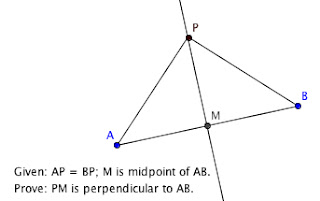
Let's take a particular idea from geometry, that the points on a perpendicular bisector are always equidistant from the endpoints of the bisected segment, through the list:
- Stage "Observe": Students are given a perpendicular bisector line and asked to measure the distance AP and BP and recognize the distances are equal.
- Stage "Apply": When asked to find a point equidistant between A and B, students construct a perpendicular bisector.
- Stage "Limitations": Students recognize that this is NOT the same thing as finding a point equal distance from two lines.
- Stage "Theorem stating": Students can say, "Every point on a perpendicular bisector are equidistant from the endpoints of the bisected segment," or, "The perpendicular bisector is the set of all points equidistant from the endpoints of the bisected segment."
- Stage "Understanding": While their understanding may be idiosyncratic, the key is recognizing that all the points P are the vertices of isosceles triangles. I think the best description I have read of insight is from Why Don't Children Like School?: an insight comes from recognizing two ideas, already understood, are related. The example the author uses is hitting a car and a baseball with a baseball bat; we know what will happen, and the connection is realizing that the force = mass x acceleration equation tells us the car will not move nearly as much as the baseball.
- Stage "Proof": Students can write a proof, usually by showing through congruent triangles that an isosceles triangle's median line is perpendicular to its base.
It is impossible to proceed into further abstraction without a solid grasp of the more concrete stages. Now, it would be ideal for students to progress all the way on every concept, but that is not necessarily possible. Advanced classes can push to the more abstract levels; mid-level classes might stop half-way through. Advanced class should NOT go through more material faster at only a middle level of abstraction. Sadly, however, many math classes -- even advanced classes -- probably stop at the application stage. Students simply do problems, but they are never asked about how all the pieces of math fit together. For all but the very weakest students, this is a loss.
Now, I hear a lot of people talk about how important it is for students to do proofs in geometry, but I think in many geometry courses, the proofs just get tacked on at the end, and the students do not have a satisfactory grasp of the earlier stages of a concept they are being asked to prove. It is better that they be asked to think at a reasonably challenging level of abstraction, and this will vary from concept to concept. For the perpendicular bisector theorem, the "understanding" stage is attainable for most students, so it is not unreasonable to do a proof. For other ideas, such as the idea that the perpendicular bisectors of the sides of the triangle meet at its circumcenter, I would expect students to stall out at the "theorem stating" stage, so a proof of this concept is out of reach. (Yes, I know the concepts are logically almost the same, but I find the complexity of working with three lines begins to overwhelm them, and it really is unattainable.)
In mathematics, sometimes the simplest ideas are the hardest to understand. Here are some topics I have found that my classes stall out at the "theorem stating" stage:
- Distance = A - B; and if B is a negative number, then the distance = A + absolute value (B).
- A radical is actually a length that can be plotted and manipulated.
- The edge of a circle is a set of points.
- A line is a set of points.
Problem-solving
The third characteristic of a good curriculum is that it gives students the opportunity to develop mathematical skills, such as number sense, estimation, and problem-solving. I think they are all important skills, but problem-solving is the most crucial in many ways. Here is my attempt to provide some vocabulary to describe good problems for practice.
First, how similar to problems the students have already seen is a problem? You can call any work in math "problem-solving," but it only really counts if the problems are novel.
Second, how many concepts do students need to pull together to solve a problem? This is the heart of problem-solving: realizing you can use a hammer and nails and a saw and a drill to make a birdhouse.
Third, how divergent are the concepts? If the students must put together a concept from geometry with another one from calculus, it is more challenging.
Fourth, how salient are the concepts? If it obvious that the triangle inequality is used to solve a problem, then this is a high salience concept. Does the problem have false leads? Does it tempt students to do X when Y is right? (Closely related to salience is how recently a concept was learned or reviewed.)
Fifth, how far must students go down a path before they can see it is right? As students practice problem-solving, their perseverance goes up, but a lot of students begin the year convinced that if a problem takes more than two steps, they must be doing it wrong.
Sixth, how difficult are the concepts? There is the question to of what students need to do with the concept. If the method requires students to use the contra positive of a known theorem, it can cause some students to nearly melt down. The converse thoroughly baffles expectations. One of my favorite arguments as a debater was, "Causality works the other direction." I would concede that there was a link between X and Y, but that, contrary to my opponent's assertion that X caused Y, it was actually Y that caused X. This caused endless difficulty for them to answer; few people could explain the causal mechanism well enough to rebut this tactic.
Seventh, how much algebra must the students do? How much translation from words to pictures or equations, or from pictures to equations? Every act of translating from one representation to another increases the complexity.
The key question is the mental load students are under to solve a problem. How many pieces are floating around, how well they understand those pieces (very familiar or still novel), the complexity of combination and operations they must do -- all these elements combine to make problems more challenging. And this is the key distinction between a regular and advanced-track student: the more advanced student is capable of making larger logical jumps to connect two ideas, of dealing with larger gaps in explanations of concepts (not struggling to move to more abstract ideas, not having difficulty moving beyond the details of concrete examples), and of seeing/remembering/using more complex patterns (seeing all the nuances and exceptions; inferring how to navigate contrapositives, converses, and inverses fluidly).
Wednesday, January 30, 2013
Brain, cognition, and teaching 2
In my previous post on the brain, cognition, and teaching, I made three main points:
My third point is one I also make by asking a rhetorical question: What is the best way for a child to play? It obviously makes no sense; children, at different times, need to play in lots of different ways. What is important is the variety. So, what is the best way to teach, to present ideas to children? For different topics, for different children, different methods work "best" -- and variety is a virtue no matter what is best. The better questions to ask are, "When is each method useful?" or, "What are characteristics of good instruction?" These are much more subtle and relevant questions.
My biggest problem with the cognitive research is that it is still at a kind of aphorism level, rather than developing specific vocabulary to help us discuss the characteristics of good lesson plans. It is like reading a home organization book that says, "Buy a spice rack," versus a different book that says, "Buy big jars of garlic, chili, cumin, and curry powders. Don't bother to buy any other jars. Instead, when recipes call for other spices, buy the exact amount you need in the self-scoop spices at your grocery store. You'll pay a higher unit price, but you'll throw away a lot less." While the first book identifies the need -- which is a good first step -- the second book layers on a concept, frequency of use, that allows us to make more sophisticated choices, even if we disagree with its particular strategy. It is worth recognizing that in education, just like kitchen management, any conceptual vocabulary we develop to characterize good lesson plans will have to be relative to the particular students, grade, etc. The frequency of spice use is an important concept to organize your kitchen, but each cook will make different decisions, based on what they actually cook. Good lesson plans will share key characteristics, but there is not one best lesson plan for a given topic.
I can think of three key characteristics of a good lesson plan or of a good curriculum:
First is the retention of key facts and ideas. A large part of retention is practice. I think about the necessary "mass" of practice (how many problems at a time), the spacing or distribution of practice (how frequently problems should return), and the kind of practice task students are asked to do. By kind of task, I am especially focused on how narrowly repetitive the task is. With a narrowly repetitive task, there is a real risk that superficial cues trigger the students' memory. Let's look at an example, the Pythagorean theorem. While this is a concept students pick up quickly, many textbooks give them whole batches of practice problems that look just like this:

There are lots of ways, large and small, to vary the context. First, all three sides could be given, and students asked to determine whether it is a right triangle. (A further exploration into using the Pythagorean theorem to tell us whether a triangle is acute, right, or obtuse is well worth the time.) Second, the students could be given a right triangle where the sides are no longer whole numbers but instead radical lengths. This can trip up enough students to make it a worthwhile review. Third, the students could be given word problems where they need to draw the picture first: "Two boys are flying a kite that gets stuck in the very top branch of a tall tree. The string is 100 feet, and the boys are 80 feet away from the tree. How tall is the tree?"
Fourth and moving onto larger ways to vary the context, students can be given problems where the use of the Pythagorean theorem is just embedded. For example:

"Given that A is the center of the circle, and that the distance from A to (1, 0) is 3 units, is this a tangent line?" Students need to use the Pythagorean theorem twice, once to find the length from (-1, 2) to (1, 0) and once to assess whether the angle between the radius and line is right. Or this:

"Given that A is the center of the circle, solve for k." It is worthwhile to note here that explicitness in naming the theorem when discussing the solution -- "Oh, this is a Pythagorean theorem problem" -- will help retention. Or a third example: using the Pythagorean theorem for three-dimensional problems.
Fifth, getting back to explicitly counting or measuring is good. Here is one example:

"(a) Using your compass, find the points on the x-axis 4 units from A. (b) Now find the exact coordinates." Or this:

"(a) Find the exact areas of the three squares. (b) How can you use the three areas to write one true equation?" We give our students this problem after they have learned the Pythagorean theorem but before they have worked with radical numbers; they find the areas of the squares by counting grid squares!
The best point out of Why Don't Children Like School? is that "memory is the residue of thought." If the review problems are well spaced but require little thought, then there is little value to them. The concept will become backgrounded: "Oh, it's a right triangle, so I square the sides..." On the other hand, good review problems require students to re-examine the concept: "It's a distance problem, so I bet the Pythagorean theorem is involved somehow..." By this logic, good review problems might only appear to be about the Pythagorean theorem. If they think it through and show that the Pythagorean theorem does not apply, students would effectively review the theorem.
To summarize, when I am thinking about whether review problems are well structured, I look at whether I have given them enough review problems in total, whether the problems are spaced out at the right frequency, and whether the problems change context sufficiently to require real remembering and thought, rather than merely triggering a superficial association.
In my next and final post in this series, I plan to talk about how one can think about students' conceptual engagement and students' mathematical skills.
- cognitive research can be meaningful even without direct knowledge of the mechanisms of the brain;
- a focus on the cognitive abilities of students -- what they can actually think through on their own -- would imply that the curriculum should be trimmed, limiting it to realistic amounts and topics;
- the divide between education traditionalists and reformers has been driven by how to present material, when it would be better to have a serious conversation about how to structure the curriculum.
My third point is one I also make by asking a rhetorical question: What is the best way for a child to play? It obviously makes no sense; children, at different times, need to play in lots of different ways. What is important is the variety. So, what is the best way to teach, to present ideas to children? For different topics, for different children, different methods work "best" -- and variety is a virtue no matter what is best. The better questions to ask are, "When is each method useful?" or, "What are characteristics of good instruction?" These are much more subtle and relevant questions.
My biggest problem with the cognitive research is that it is still at a kind of aphorism level, rather than developing specific vocabulary to help us discuss the characteristics of good lesson plans. It is like reading a home organization book that says, "Buy a spice rack," versus a different book that says, "Buy big jars of garlic, chili, cumin, and curry powders. Don't bother to buy any other jars. Instead, when recipes call for other spices, buy the exact amount you need in the self-scoop spices at your grocery store. You'll pay a higher unit price, but you'll throw away a lot less." While the first book identifies the need -- which is a good first step -- the second book layers on a concept, frequency of use, that allows us to make more sophisticated choices, even if we disagree with its particular strategy. It is worth recognizing that in education, just like kitchen management, any conceptual vocabulary we develop to characterize good lesson plans will have to be relative to the particular students, grade, etc. The frequency of spice use is an important concept to organize your kitchen, but each cook will make different decisions, based on what they actually cook. Good lesson plans will share key characteristics, but there is not one best lesson plan for a given topic.
I can think of three key characteristics of a good lesson plan or of a good curriculum:
- it is set up to help students retain key facts and ideas;
- it is set up to engage students in thinking conceptually about what they are doing, so in other words, the lesson plan or curriculum is set up to make sure students have an abstract understanding of the key facts and ideas;
- it is set up to give students opportunities to develop general mathematical skills, such as estimating, problem-solving, proof-writing, etc.
Retention
First is the retention of key facts and ideas. A large part of retention is practice. I think about the necessary "mass" of practice (how many problems at a time), the spacing or distribution of practice (how frequently problems should return), and the kind of practice task students are asked to do. By kind of task, I am especially focused on how narrowly repetitive the task is. With a narrowly repetitive task, there is a real risk that superficial cues trigger the students' memory. Let's look at an example, the Pythagorean theorem. While this is a concept students pick up quickly, many textbooks give them whole batches of practice problems that look just like this:
There are lots of ways, large and small, to vary the context. First, all three sides could be given, and students asked to determine whether it is a right triangle. (A further exploration into using the Pythagorean theorem to tell us whether a triangle is acute, right, or obtuse is well worth the time.) Second, the students could be given a right triangle where the sides are no longer whole numbers but instead radical lengths. This can trip up enough students to make it a worthwhile review. Third, the students could be given word problems where they need to draw the picture first: "Two boys are flying a kite that gets stuck in the very top branch of a tall tree. The string is 100 feet, and the boys are 80 feet away from the tree. How tall is the tree?"
Fourth and moving onto larger ways to vary the context, students can be given problems where the use of the Pythagorean theorem is just embedded. For example:
"Given that A is the center of the circle, and that the distance from A to (1, 0) is 3 units, is this a tangent line?" Students need to use the Pythagorean theorem twice, once to find the length from (-1, 2) to (1, 0) and once to assess whether the angle between the radius and line is right. Or this:
"Given that A is the center of the circle, solve for k." It is worthwhile to note here that explicitness in naming the theorem when discussing the solution -- "Oh, this is a Pythagorean theorem problem" -- will help retention. Or a third example: using the Pythagorean theorem for three-dimensional problems.
Fifth, getting back to explicitly counting or measuring is good. Here is one example:
"(a) Using your compass, find the points on the x-axis 4 units from A. (b) Now find the exact coordinates." Or this:
"(a) Find the exact areas of the three squares. (b) How can you use the three areas to write one true equation?" We give our students this problem after they have learned the Pythagorean theorem but before they have worked with radical numbers; they find the areas of the squares by counting grid squares!
The best point out of Why Don't Children Like School? is that "memory is the residue of thought." If the review problems are well spaced but require little thought, then there is little value to them. The concept will become backgrounded: "Oh, it's a right triangle, so I square the sides..." On the other hand, good review problems require students to re-examine the concept: "It's a distance problem, so I bet the Pythagorean theorem is involved somehow..." By this logic, good review problems might only appear to be about the Pythagorean theorem. If they think it through and show that the Pythagorean theorem does not apply, students would effectively review the theorem.
To summarize, when I am thinking about whether review problems are well structured, I look at whether I have given them enough review problems in total, whether the problems are spaced out at the right frequency, and whether the problems change context sufficiently to require real remembering and thought, rather than merely triggering a superficial association.
In my next and final post in this series, I plan to talk about how one can think about students' conceptual engagement and students' mathematical skills.
Wednesday, January 16, 2013
Brain, cognition, and teaching 1
I get these mailings from time to time about brain research and teaching. Well. I am interested, but I am always worried that the ideas presented would be too reductionist. One reason is that brain research is in such a preliminary state. The second, far more important reason is that what I really want to understand is cognition -- the software, not the hardware. Researchers have done plenty of work to study how people learn, remember, and so on without knowing anything about the physical mechanisms. A study purely of psychological patterns is sufficient to inform teaching.
I went to graduate school to read the research on cognition and instruction, the applied psychology of the classroom. Researchers have done experiments and have compared classroom methods across cultures. Some of the methods/techniques they have investigated (and found evidence for) are specific, like the spacing effect on memory. Some of the methods/techniques they have investigated are more general, such as how teachers' questioning strategies affects student learning. (See Why Don't Children Like School? for a readable summary of some key research.) Overall, there is a lot of different evidence to support these ideas:
I am lucky I started teaching in debate, where there is no set curriculum, and I was left to my own devices to figure out what my students could use to become better debaters and more critical thinkers. I realized quickly that, although I wanted my students to understand deontological and consequentialist thinking, reading original texts was not helpful. Better to explain the ideas simply, and then give them scenarios to evaluate from both perspectives. The same with logic: formal logic was not helpful, but it was useful to show them more basic models (Toulmin's model, Venn diagrams, Ishikawa diagrams, etc.) and have them spend the time looking at an argument and clearly articulating the assumptions and analyzing its flaws. The practical applications -- what they could actually do in analyzing examples of actual, real-world arguments -- was far more important than how far we got into pure, theoretical logic. I still have a desire to write a book with a couple simple models and lots of arguments from different fields (law, politics, economics, etc.) to analyze. It would be a double benefit: the students would get exposure to key social science theories, say, the Keynes/Hayek debate/rap battle about fiat money, as well as getting lots of practice diagraming arguments.
A similar situation occurred when I first started teaching public speaking (the second course I taught on my own): it was the Wild West, and we played around with what concepts to teach and far to go into each one, and we did what seemed best for our students. When I realized that putting together a persuasive speech was extremely difficult for my students -- that we would need to spend weeks on just recognizing the difference between a logical argument and an emotional appeal -- I just said to heck with it and dropped the persuasive speech. Do I think everyone ought to learn the difference between an argument and an emotional appeal? Of course. But I also think everyone ought to learn about self-selection/survivor bias, utilitarianism, Venn diagrams, Taylor series, statistical inferences from sampling distributions, etc., etc. Public speaking can not accommodate it all. At a certain point, one has to evaluate what the students can actually do, and if one is presenting a topic for its own sake alone, then it ought to be cut. So, I added another speech, a demonstration speech, which proved challenging (but reasonably so) for them.
I am lucky that a math course was not my first or second teaching assignment, because I knew by the time I got around to teaching math to trust my gut about whether a concept was "a bridge too far" for students. The edifice of the math curriculum is imposing, because there appears to be such an absolute, inviolable need to cover every concept so students are prepared for the next course. The new teacher can be overwhelmed: "I have to cover completing the square, or else I've set them up for failure next year!" But this inviolability is mostly just an appearance: there is substantial overlap from course to course, and topics get repeated; it is far more important than students understand what they are doing than they cover every topic poorly.
Despite the fact that the four ideas I outlined above are clearly supported by research evidence, they have not really won over mathematics textbook publishers, school districts, parents, and teachers. Books continue to cover concepts in logically grouped topic units, and once the unit test is over, the concept is barely referred to or used again. Asking kids tough questions that require some problem-solving or deep thinking makes parents uncomfortable: "My child says he doesn't get it. Aren't you showing them how to do it?" (Yes, and then we ask them to do it on their own for real, in hard but achievably challenging problems, which discomfits some students!) And teaching metacognitive strategies and emphasizing clear communication are derided as fuzzy and not worth the time.
Perhaps a big part of the divide is because reformers and traditionalists have gotten hung up on the original presentation of the material: lecture or discovery. While I do like to have students experience some discovery, I always follow-up to clarify and help them clearly formulate the key ideas. If an idea does not lend itself to discovery, then I am willing to lecture -- but I immediately ask my students to put the idea into use. It seems like various, mixed instructional techniques can be appropriate. The specific presentation and instruction techniques are less important than structuring the curriculum to provide ample, challenging practice to students, plenty of feedback, and the repetition and integration of topics. Besides, discovery is only one stage in the process of mathematics; there are many meaningful things the teacher can ask them to do at other stages. The discussion reformers and traditionalist ought to have is about the curriculum and assessment, not the instruction, because then they will be able to find common ground; who disagrees with mixed review? Who disagrees with continual feedback? (The May/June 2012 Washington Monthly ran a fascinating focus on educational testing; here is one article about using computers to provide automated feedback to students, which seems like a good idea if it is done under the supervision of a good teacher. It is also why the Virginia Tech math emporium could be a neat model as well.)
The issue now is that the cognitive research has not yet created a rich vocabulary that details the minutiae of curriculum choices teachers face every day. The research is still quite broad-stroke. It is like buying a home organization book that gives good but broad advice, such as, "Throw out anything you are not using!," versus a book that has specific, concrete advice on how to store spices, sports equipment, toiletries, and that comes with pictures of successful examples. In the next post, I will discuss some of the key issues that I find come up with math instruction and try to develop some vocabulary around it.
I went to graduate school to read the research on cognition and instruction, the applied psychology of the classroom. Researchers have done experiments and have compared classroom methods across cultures. Some of the methods/techniques they have investigated (and found evidence for) are specific, like the spacing effect on memory. Some of the methods/techniques they have investigated are more general, such as how teachers' questioning strategies affects student learning. (See Why Don't Children Like School? for a readable summary of some key research.) Overall, there is a lot of different evidence to support these ideas:
- students retain information and concepts best when these are used intermittently, spread out over a semester
- students learn concepts best when they are asked medium-to-difficult questions about why something works (or are given tough application questions), rather than asked low-level information questions -- too easy, and the concept does not stick; too hard, and the students are lost
- students learn concepts best when they are shown specific metacognitive strategies to help them evaluate their own thinking
- communication matters: the act of trying to explain an concept clearly helps students solidify their understanding of it
I am lucky I started teaching in debate, where there is no set curriculum, and I was left to my own devices to figure out what my students could use to become better debaters and more critical thinkers. I realized quickly that, although I wanted my students to understand deontological and consequentialist thinking, reading original texts was not helpful. Better to explain the ideas simply, and then give them scenarios to evaluate from both perspectives. The same with logic: formal logic was not helpful, but it was useful to show them more basic models (Toulmin's model, Venn diagrams, Ishikawa diagrams, etc.) and have them spend the time looking at an argument and clearly articulating the assumptions and analyzing its flaws. The practical applications -- what they could actually do in analyzing examples of actual, real-world arguments -- was far more important than how far we got into pure, theoretical logic. I still have a desire to write a book with a couple simple models and lots of arguments from different fields (law, politics, economics, etc.) to analyze. It would be a double benefit: the students would get exposure to key social science theories, say, the Keynes/Hayek debate/rap battle about fiat money, as well as getting lots of practice diagraming arguments.
A similar situation occurred when I first started teaching public speaking (the second course I taught on my own): it was the Wild West, and we played around with what concepts to teach and far to go into each one, and we did what seemed best for our students. When I realized that putting together a persuasive speech was extremely difficult for my students -- that we would need to spend weeks on just recognizing the difference between a logical argument and an emotional appeal -- I just said to heck with it and dropped the persuasive speech. Do I think everyone ought to learn the difference between an argument and an emotional appeal? Of course. But I also think everyone ought to learn about self-selection/survivor bias, utilitarianism, Venn diagrams, Taylor series, statistical inferences from sampling distributions, etc., etc. Public speaking can not accommodate it all. At a certain point, one has to evaluate what the students can actually do, and if one is presenting a topic for its own sake alone, then it ought to be cut. So, I added another speech, a demonstration speech, which proved challenging (but reasonably so) for them.
I am lucky that a math course was not my first or second teaching assignment, because I knew by the time I got around to teaching math to trust my gut about whether a concept was "a bridge too far" for students. The edifice of the math curriculum is imposing, because there appears to be such an absolute, inviolable need to cover every concept so students are prepared for the next course. The new teacher can be overwhelmed: "I have to cover completing the square, or else I've set them up for failure next year!" But this inviolability is mostly just an appearance: there is substantial overlap from course to course, and topics get repeated; it is far more important than students understand what they are doing than they cover every topic poorly.
Despite the fact that the four ideas I outlined above are clearly supported by research evidence, they have not really won over mathematics textbook publishers, school districts, parents, and teachers. Books continue to cover concepts in logically grouped topic units, and once the unit test is over, the concept is barely referred to or used again. Asking kids tough questions that require some problem-solving or deep thinking makes parents uncomfortable: "My child says he doesn't get it. Aren't you showing them how to do it?" (Yes, and then we ask them to do it on their own for real, in hard but achievably challenging problems, which discomfits some students!) And teaching metacognitive strategies and emphasizing clear communication are derided as fuzzy and not worth the time.
Perhaps a big part of the divide is because reformers and traditionalists have gotten hung up on the original presentation of the material: lecture or discovery. While I do like to have students experience some discovery, I always follow-up to clarify and help them clearly formulate the key ideas. If an idea does not lend itself to discovery, then I am willing to lecture -- but I immediately ask my students to put the idea into use. It seems like various, mixed instructional techniques can be appropriate. The specific presentation and instruction techniques are less important than structuring the curriculum to provide ample, challenging practice to students, plenty of feedback, and the repetition and integration of topics. Besides, discovery is only one stage in the process of mathematics; there are many meaningful things the teacher can ask them to do at other stages. The discussion reformers and traditionalist ought to have is about the curriculum and assessment, not the instruction, because then they will be able to find common ground; who disagrees with mixed review? Who disagrees with continual feedback? (The May/June 2012 Washington Monthly ran a fascinating focus on educational testing; here is one article about using computers to provide automated feedback to students, which seems like a good idea if it is done under the supervision of a good teacher. It is also why the Virginia Tech math emporium could be a neat model as well.)
The issue now is that the cognitive research has not yet created a rich vocabulary that details the minutiae of curriculum choices teachers face every day. The research is still quite broad-stroke. It is like buying a home organization book that gives good but broad advice, such as, "Throw out anything you are not using!," versus a book that has specific, concrete advice on how to store spices, sports equipment, toiletries, and that comes with pictures of successful examples. In the next post, I will discuss some of the key issues that I find come up with math instruction and try to develop some vocabulary around it.
Subscribe to:
Posts (Atom)