Showing posts with label brain research. Show all posts

Monday, February 25, 2013

Brain, cognition, and teaching 3

Teaching can be an isolated profession. It is why I do this blog: more for my own desire to communicate the things I think through on a daily basis, rather than for fame or money. I think that perhaps the most effective professional development, in dollars for benefit, is simply to pay teachers of the same subject to sit down and talk about the curriculum and instruction, with no explicit goal except sharing ideas. The keys to quality teaching are: to have the teacher think through how to order the concepts in a subject in a way that reasonably challenge the students and to think about ways to set up the classroom such that students do the thinking for themselves. No more, no less.

I have mentioned that I think there are three key characteristics of a good lesson plan or of a good curriculum:
  1. it is set up to help students retain key facts and ideas;
  2. it is set up to engage students in thinking conceptually about what they are doing, so in other words, the lesson plan or curriculum is set up to make sure students have an abstract understanding of the key facts and ideas;
  3. it is set up to give students opportunities to develop general mathematical skills, such as estimating, problem-solving, proof-writing, etc.
These are the "buy a spice rack" ideas. In my last post in this series, I discussed the structuring of review problems, specifically by varying the contexts in which the concepts are presented. In this post, I discuss the second and third characteristics.

Abstraction


The second characteristic is really about abstraction, and one could think of Bloom's taxonomy. A modified version for mathematics is:
  • the student can recognize a pattern
  • the students can use the pattern
  • the students can see the limits to the pattern
  • the students can formulate the pattern clearly in their own words
  • the students can understand why the pattern works
  • the students can offer a solid proof of why the pattern works
Let's take a particular idea from geometry, that the points on a perpendicular bisector are always equidistant from the endpoints of the bisected segment, through the list:


  • Stage "Observe": Students are given a perpendicular bisector line and asked to measure the distance AP and BP and recognize the distances are equal.
  • Stage "Apply": When asked to find a point equidistant between A and B, students construct a perpendicular bisector.
  • Stage "Limitations": Students recognize that this is NOT the same thing as finding a point equal distance from two lines.
  • Stage "Theorem stating": Students can say, "Every point on a perpendicular bisector are equidistant from the endpoints of the bisected segment," or, "The perpendicular bisector is the set of all points equidistant from the endpoints of the bisected segment."
  • Stage "Understanding": While their understanding may be idiosyncratic, the key is recognizing that all the points P are the vertices of isosceles triangles. I think the best description I have read of insight is from Why Don't Children Like School?: an insight comes from recognizing two ideas, already understood, are related. The example the author uses is hitting a car and a baseball with a baseball bat; we know what will happen, and the connection is realizing that the force = mass x acceleration equation tells us the car will not move nearly as much as the baseball.
  • Stage "Proof": Students can write a proof, usually by showing through congruent triangles that an isosceles triangle's median line is perpendicular to its base.
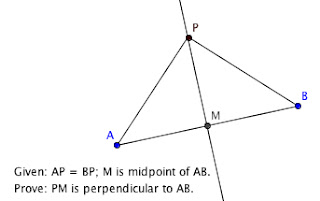


It is impossible to proceed into further abstraction without a solid grasp of the more concrete stages. Now, it would be ideal for students to progress all the way on every concept, but that is not necessarily possible. Advanced classes can push to the more abstract levels; mid-level classes might stop half-way through. Advanced class should NOT go through more material faster at only a middle level of abstraction. Sadly, however, many math classes -- even advanced classes -- probably stop at the application stage. Students simply do problems, but they are never asked about how all the pieces of math fit together. For all but the very weakest students, this is a loss.

Now, I hear a lot of people talk about how important it is for students to do proofs in geometry, but I think in many geometry courses, the proofs just get tacked on at the end, and the students do not have a satisfactory grasp of the earlier stages of a concept they are being asked to prove. It is better that they be asked to think at a reasonably challenging level of abstraction, and this will vary from concept to concept. For the perpendicular bisector theorem, the "understanding" stage is attainable for most students, so it is not unreasonable to do a proof. For other ideas, such as the idea that the perpendicular bisectors of the sides of the triangle meet at its circumcenter, I would expect students to stall out at the "theorem stating" stage, so a proof of this concept is out of reach. (Yes, I know the concepts are logically almost the same, but I find the complexity of working with three lines begins to overwhelm them, and it really is unattainable.)

In mathematics, sometimes the simplest ideas are the hardest to understand. Here are some topics I have found that my classes stall out at the "theorem stating" stage:

- Distance = A - B; and if B is a negative number, then the distance = A + absolute value (B).
- A radical is actually a length that can be plotted and manipulated.
- The edge of a circle is a set of points.
- A line is a set of points.

Even though my classes will not prove these concepts, that does not make the concepts any less worthwhile. Proofs are good where appropriate, but they are not the only way to induce students to think abstractly about the mathematical interconnections. Questions like, "Will the pattern work here?," "State this idea in your own words," and "Explain why..." demand a more thoughtful approach than plug-and-chug, especially when the teacher holds the students to high standards. A fantastic example of very abstract thinking, requiring no proofs, is to ask students to categorize quadrilaterals into "families" based on shared properties.

Problem-solving


The third characteristic of a good curriculum is that it gives students the opportunity to develop mathematical skills, such as number sense, estimation, and problem-solving. I think they are all important skills, but problem-solving is the most crucial in many ways. Here is my attempt to provide some vocabulary to describe good problems for practice.


First, how similar to problems the students have already seen is a problem? You can call any work in math "problem-solving," but it only really counts if the problems are novel.

Second, how many concepts do students need to pull together to solve a problem? This is the heart of problem-solving: realizing you can use a hammer and nails and a saw and a drill to make a birdhouse.

Third, how divergent are the concepts? If the students must put together a concept from geometry with another one from calculus, it is more challenging.

Fourth, how salient are the concepts? If it obvious that the triangle inequality is used to solve a problem, then this is a high salience concept. Does the problem have false leads? Does it tempt students to do X when Y is right? (Closely related to salience is how recently a concept was learned or reviewed.)

Fifth, how far must students go down a path before they can see it is right? As students practice problem-solving, their perseverance goes up, but a lot of students begin the year convinced that if a problem takes more than two steps, they must be doing it wrong.

Sixth, how difficult are the concepts? There is the question to of what students need to do with the concept. If the method requires students to use the contra positive of a known theorem, it can cause some students to nearly melt down. The converse thoroughly baffles expectations. One of my favorite arguments as a debater was, "Causality works the other direction." I would concede that there was a link between X and Y, but that, contrary to my opponent's assertion that X caused Y, it was actually Y that caused X. This caused endless difficulty for them to answer; few people could explain the causal mechanism well enough to rebut this tactic.

Seventh, how much algebra must the students do? How much translation from words to pictures or equations, or from pictures to equations? Every act of translating from one representation to another increases the complexity.


The key question is the mental load students are under to solve a problem. How many pieces are floating around, how well they understand those pieces (very familiar or still novel), the complexity of combination and operations they must do -- all these elements combine to make problems more challenging. And this is the key distinction between a regular and advanced-track student: the more advanced student is capable of making larger logical jumps to connect two ideas, of dealing with larger gaps in explanations of concepts (not struggling to move to more abstract ideas, not having difficulty moving beyond the details of concrete examples), and of seeing/remembering/using more complex patterns (seeing all the nuances and exceptions; inferring how to navigate contrapositives, converses, and inverses fluidly).

Wednesday, January 30, 2013

Brain, cognition, and teaching 2

In my previous post on the brain, cognition, and teaching, I made three main points:
  1. cognitive research can be meaningful even without direct knowledge of the mechanisms of the brain;
  2. a focus on the cognitive abilities of students -- what they can actually think through on their own -- would imply that the curriculum should be trimmed, limiting it to realistic amounts and topics;
  3. the divide between education traditionalists and reformers has been driven by how to present material, when it would be better to have a serious conversation about how to structure the curriculum.
As for the second point, one idea to discuss is a comparison of the math curriculum internationally, to see how different countries spend class time. I would never make an argument for dumbing down the curriculum -- it is about increasing the depth of study of core topics, rather than covering many topics shallowly. I would suspect that other countries' focus on fewer topics has a lot to do with better results, but the data are clouded by an apples-to-oranges comparison. But I could give one example from the U.S. math curriculum: in algebra 1, students study linear equations and quadratic functions; maybe again in geometry; definitely again in algebra 2 at the same difficulty level; and students could still be doing significant remedial work on basic lines and quadratic functions in pre-calculus. While it is good for students to continue to practice with ideas, the problems should be getting more difficult, and anyway, this repetition is only a good strategy if they actually understand an idea and are truly practicing it, not relearning it. There is reason to believe that lines are introduced too early. As another example, geometry is stuffed full of theorems and proofs, but it is far more important for students to understand distance, coordinate transformations, using parallel and perpendicular slopes, and that a line or function or circle's boundary is a really an infinite set of points satisfying an equation.

My third point is one I also make by asking a rhetorical question: What is the best way for a child to play? It obviously makes no sense; children, at different times, need to play in lots of different ways. What is important is the variety. So, what is the best way to teach, to present ideas to children? For different topics, for different children, different methods work "best" -- and variety is a virtue no matter what is best. The better questions to ask are, "When is each method useful?" or, "What are characteristics of good instruction?" These are much more subtle and relevant questions.

My biggest problem with the cognitive research is that it is still at a kind of aphorism level, rather than developing specific vocabulary to help us discuss the characteristics of good lesson plans. It is like reading a home organization book that says, "Buy a spice rack," versus a different book that says, "Buy big jars of garlic, chili, cumin, and curry powders. Don't bother to buy any other jars. Instead, when recipes call for other spices, buy the exact amount you need in the self-scoop spices at your grocery store. You'll pay a higher unit price, but you'll throw away a lot less." While the first book identifies the need -- which is a good first step -- the second book layers on a concept, frequency of use, that allows us to make more sophisticated choices, even if we disagree with its particular strategy. It is worth recognizing that in education, just like kitchen management, any conceptual vocabulary we develop to characterize good lesson plans will have to be relative to the particular students, grade, etc. The frequency of spice use is an important concept to organize your kitchen, but each cook will make different decisions, based on what they actually cook. Good lesson plans will share key characteristics, but there is not one best lesson plan for a given topic.

I can think of three key characteristics of a good lesson plan or of a good curriculum:
  1. it is set up to help students retain key facts and ideas;
  2. it is set up to engage students in thinking conceptually about what they are doing, so in other words, the lesson plan or curriculum is set up to make sure students have an abstract understanding of the key facts and ideas;
  3. it is set up to give students opportunities to develop general mathematical skills, such as estimating, problem-solving, proof-writing, etc.
Those are your "buy a spice rack" ideas. Now to get into more specific ideas.

Retention


First is the retention of key facts and ideas. A large part of retention is practice. I think about the necessary "mass" of practice (how many problems at a time), the spacing or distribution of practice (how frequently problems should return), and the kind of practice task students are asked to do. By kind of task, I am especially focused on how narrowly repetitive the task is. With a narrowly repetitive task, there is a real risk that superficial cues trigger the students' memory. Let's look at an example, the Pythagorean theorem. While this is a concept students pick up quickly, many textbooks give them whole batches of practice problems that look just like this:


There are lots of ways, large and small, to vary the context. First, all three sides could be given, and students asked to determine whether it is a right triangle. (A further exploration into using the Pythagorean theorem to tell us whether a triangle is acute, right, or obtuse is well worth the time.) Second, the students could be given a right triangle where the sides are no longer whole numbers but instead radical lengths. This can trip up enough students to make it a worthwhile review. Third, the students could be given word problems where they need to draw the picture first: "Two boys are flying a kite that gets stuck in the very top branch of a tall tree. The string is 100 feet, and the boys are 80 feet away from the tree. How tall is the tree?"

Fourth and moving onto larger ways to vary the context, students can be given problems where the use of the Pythagorean theorem is just embedded. For example:


"Given that A is the center of the circle, and that the distance from A to (1, 0) is 3 units, is this a tangent line?" Students need to use the Pythagorean theorem twice, once to find the length from (-1, 2) to (1, 0) and once to assess whether the angle between the radius and line is right. Or this:


"Given that A is the center of the circle, solve for k." It is worthwhile to note here that explicitness in naming the theorem when discussing the solution -- "Oh, this is a Pythagorean theorem problem" -- will help retention. Or a third example: using the Pythagorean theorem for three-dimensional problems.

Fifth, getting back to explicitly counting or measuring is good. Here is one example:


"(a) Using your compass, find the points on the x-axis 4 units from A. (b) Now find the exact coordinates." Or this:


"(a) Find the exact areas of the three squares. (b) How can you use the three areas to write one true equation?" We give our students this problem after they have learned the Pythagorean theorem but before they have worked with radical numbers; they find the areas of the squares by counting grid squares!

The best point out of Why Don't Children Like School? is that "memory is the residue of thought." If the review problems are well spaced but require little thought, then there is little value to them. The concept will become backgrounded: "Oh, it's a right triangle, so I square the sides..." On the other hand, good review problems require students to re-examine the concept: "It's a distance problem, so I bet the Pythagorean theorem is involved somehow..." By this logic, good review problems might only appear to be about the Pythagorean theorem. If they think it through and show that the Pythagorean theorem does not apply, students would effectively review the theorem.

To summarize, when I am thinking about whether review problems are well structured, I look at whether I have given them enough review problems in total, whether the problems are spaced out at the right frequency, and whether the problems change context sufficiently to require real remembering and thought, rather than merely triggering a superficial association.

In my next and final post in this series, I plan to talk about how one can think about students' conceptual engagement and students' mathematical skills.

Wednesday, January 16, 2013

Brain, cognition, and teaching 1

I get these mailings from time to time about brain research and teaching. Well. I am interested, but I am always worried that the ideas presented would be too reductionist. One reason is that brain research is in such a preliminary state. The second, far more important reason is that what I really want to understand is cognition -- the software, not the hardware. Researchers have done plenty of work to study how people learn, remember, and so on without knowing anything about the physical mechanisms. A study purely of psychological patterns is sufficient to inform teaching.

I went to graduate school to read the research on cognition and instruction, the applied psychology of the classroom. Researchers have done experiments and have compared classroom methods across cultures. Some of the methods/techniques they have investigated (and found evidence for) are specific, like the spacing effect on memory. Some of the methods/techniques they have investigated are more general, such as how teachers' questioning strategies affects student learning. (See Why Don't Children Like School? for a readable summary of some key research.) Overall, there is a lot of different evidence to support these ideas:
  • students retain information and concepts best when these are used intermittently, spread out over a semester
  • students learn concepts best when they are asked medium-to-difficult questions about why something works (or are given tough application questions), rather than asked low-level information questions -- too easy, and the concept does not stick; too hard, and the students are lost
  • students learn concepts best when they are shown specific metacognitive strategies to help them evaluate their own thinking
  • communication matters: the act of trying to explain an concept clearly helps students solidify their understanding of it
While these ideas strike me as uncontroversial, they all put student thinking at the center of the classroom (by which I mean, the teacher's central focus is on what every student can think, do, and explain on his own), and they all de-emphasize content for its own sake (cutting information that students are not able to actually understand in the time allotted) -- and this focus is enormously controversial. It is fair to say that education has historically been more focused on content transfer, with less thought given to the cognitive skills of students. Of course, the content taught is important, but a presentation of the content faster than students can understand it seems pointless.

I am lucky I started teaching in debate, where there is no set curriculum, and I was left to my own devices to figure out what my students could use to become better debaters and more critical thinkers. I realized quickly that, although I wanted my students to understand deontological and consequentialist thinking, reading original texts was not helpful. Better to explain the ideas simply, and then give them scenarios to evaluate from both perspectives. The same with logic: formal logic was not helpful, but it was useful to show them more basic models (Toulmin's model, Venn diagrams, Ishikawa diagrams, etc.) and have them spend the time looking at an argument and clearly articulating the assumptions and analyzing its flaws. The practical applications -- what they could actually do in analyzing examples of actual, real-world arguments -- was far more important than how far we got into pure, theoretical logic. I still have a desire to write a book with a couple simple models and lots of arguments from different fields (law, politics, economics, etc.) to analyze. It would be a double benefit: the students would get exposure to key social science theories, say, the Keynes/Hayek debate/rap battle about fiat money, as well as getting lots of practice diagraming arguments.

A similar situation occurred when I first started teaching public speaking (the second course I taught on my own): it was the Wild West, and we played around with what concepts to teach and far to go into each one, and we did what seemed best for our students. When I realized that putting together a persuasive speech was extremely difficult for my students -- that we would need to spend weeks on just recognizing the difference between a logical argument and an emotional appeal -- I just said to heck with it and dropped the persuasive speech. Do I think everyone ought to learn the difference between an argument and an emotional appeal? Of course. But I also think everyone ought to learn about self-selection/survivor bias, utilitarianism, Venn diagrams, Taylor series, statistical inferences from sampling distributions, etc., etc. Public speaking can not accommodate it all. At a certain point, one has to evaluate what the students can actually do, and if one is presenting a topic for its own sake alone, then it ought to be cut. So, I added another speech, a demonstration speech, which proved challenging (but reasonably so) for them.

I am lucky that a math course was not my first or second teaching assignment, because I knew by the time I got around to teaching math to trust my gut about whether a concept was "a bridge too far" for students. The edifice of the math curriculum is imposing, because there appears to be such an absolute, inviolable need to cover every concept so students are prepared for the next course. The new teacher can be overwhelmed: "I have to cover completing the square, or else I've set them up for failure next year!" But this inviolability is mostly just an appearance: there is substantial overlap from course to course, and topics get repeated; it is far more important than students understand what they are doing than they cover every topic poorly.

Despite the fact that the four ideas I outlined above are clearly supported by research evidence, they have not really won over mathematics textbook publishers, school districts, parents, and teachers. Books continue to cover concepts in logically grouped topic units, and once the unit test is over, the concept is barely referred to or used again. Asking kids tough questions that require some problem-solving or deep thinking makes parents uncomfortable: "My child says he doesn't get it. Aren't you showing them how to do it?" (Yes, and then we ask them to do it on their own for real, in hard but achievably challenging problems, which discomfits some students!) And teaching metacognitive strategies and emphasizing clear communication are derided as fuzzy and not worth the time.

Perhaps a big part of the divide is because reformers and traditionalists have gotten hung up on the original presentation of the material: lecture or discovery. While I do like to have students experience some discovery, I always follow-up to clarify and help them clearly formulate the key ideas. If an idea does not lend itself to discovery, then I am willing to lecture -- but I immediately ask my students to put the idea into use. It seems like various, mixed instructional techniques can be appropriate. The specific presentation and instruction techniques are less important than structuring the curriculum to provide ample, challenging practice to students, plenty of feedback, and the repetition and integration of topics. Besides, discovery is only one stage in the process of mathematics; there are many meaningful things the teacher can ask them to do at other stages. The discussion reformers and traditionalist ought to have is about the curriculum and assessment, not the instruction, because then they will be able to find common ground; who disagrees with mixed review? Who disagrees with continual feedback? (The May/June 2012 Washington Monthly ran a fascinating focus on educational testing; here is one article about using computers to provide automated feedback to students, which seems like a good idea if it is done under the supervision of a good teacher. It is also why the Virginia Tech math emporium could be a neat model as well.)

The issue now is that the cognitive research has not yet created a rich vocabulary that details the minutiae of curriculum choices teachers face every day. The research is still quite broad-stroke. It is like buying a home organization book that gives good but broad advice, such as, "Throw out anything you are not using!," versus a book that has specific, concrete advice on how to store spices, sports equipment, toiletries, and that comes with pictures of successful examples. In the next post, I will discuss some of the key issues that I find come up with math instruction and try to develop some vocabulary around it.